Thursday, May 20, 2010

Leading Indicator Surveys Flashing Red

Two leading indicator surveys suggest that the rebound in the US economy may be stalling (perhaps explaining the significant decline in the equity markets over the last few days). The ECRI Weekly Leading Index declined by 2% for the week ending May 7th, the lowest weekly decline since October 17, 2008. While this index has periodically declined from week to week over the past year, the 2% drop is significantly greater than any posting since the market bottomed last March (see 1st chart below).

In a similar vein, the Conference Board’s Monthly Leading Index survey experienced its first decline in April, falling a modest .1% (see second chart). While relatively small, the decline represents the first negative data point since March 2009 when the index fell .2%, only to be followed by a sharp rebound in April. Given that the market bottomed on March 9, 2009, most people view this survey as a remarkably prescient reading on were the market and economy are heading. While leading indicator surveys provide little insight into valuations and underlying fundamentals for individual companies, the fact that both surveys are flashing negative warning signs ought not to be dismissed by investors.


Wednesday, May 19, 2010

Shanghai Property Sales Hit Five Year Low

Homes sales in Shanghai fell to a 5 year low last week as measures put in place to curb real estate speculation in China appear to be gaining traction. According to Bloomberg, (“Shanghai Home Sales to 5 Year Low”) sales of new homes from May 10 to May 16 fell 16 percent to 60,000 square meters from the week before, the lowest level for the same period since 2005. Despite the sharp fall in volumes, average home prices in Shanghai rose 21 percent to 24,833 yuan per square meter during the month. Price increases in Shanghai are exceeding the national average, which rose 12.8% in April as reported last week by China’s National Bureau of Statistics (see chart below).


While difficult to draw too many conclusions from one week’s worth of data, the sharp falloff in Shanghai property sales has certainly spooked the market, with the country’s main stock index down 21% year-to-date, over 25% from its peak in August 2009, and nearly 10% in May alone. Chinese property developers and commodity sensitive equities have been getting crushed as well.


Friday, May 14, 2010

An ATM That Dispense Gold

While I have been advocating gold for some time and continue to believe it represents an appropriate hedge in one’s portfolio, pictures like the one below suggest we could be setting the stage for a massive bubble. As frightened Europeans turn their rapidly depreciating euros into hard assets, we will likely see continued upward pressure on the price of gold.

Though it feels good to be riding the wave, at some point central banks will be forced to stop speculative runs on their currency. Though I believe we are months and perhaps years away from such a situation playing out, investors chasing the rally in the yellow metal ought to pay close attention to the commentary emanating from the world’s major central banks. With pledges to keep interest rates at zero, endless guarantees afforded to private sector banks, and incessant money printing, central banks are clearly communicating a message that forestalling a deflationary debt unwind remains priority number one. As such, investors are acting perfectly rationally by selling currencies and buying gold.

However, I am under no illusion that buying gold is a one way bet. Personally, I think we breach the previous inflation adjusted gold price of $2200/ton before central banks feel compelled to defend their currencies (particularly the United States). Again, that day may be some ways off, but at some point inflationary forces building in the economy will force the hands of the supposed protectors of fiat currency.

Tuesday, May 11, 2010

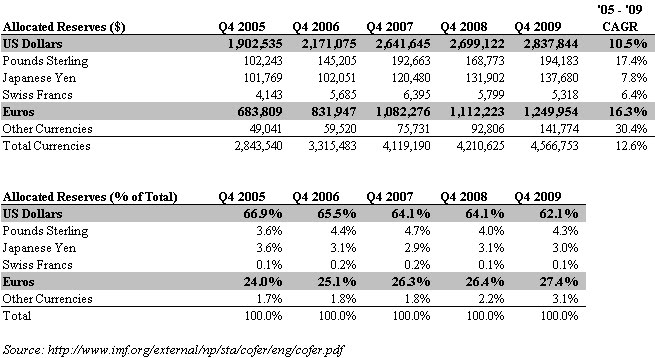
Foreign Exchange Reserves by Currency

Here is a great chart from the IMF that shows a breakout of foreign exchange reserves by currency. The key takeaway from the data is that the euro has increasingly grown its share of foreign exchange reserves over the last five years. As of Q4 2009, the euro accounted for 27.4% of foreign currency reserves vs. 24.0% in 2005. Conversely, the dollar’s share of foreign currency reserves has shrunk from 66.9% in 2005 to 62.1% as of Q4 2009. Collectively, the two currencies account for 89.4% of total foreign reserves, with the pound (4.3% of total), yen (3%), and other miscellaneous currencies accounting for the remainder.


Given recent events in the euro zone, I would imagine we see a reallocation away from the euro into the dollar, yen, and hard currencies. Perhaps the biggest beneficiary will be gold, which as I write this post is making new all time highs.

As I have suggested in prior posts, most Asian nations (China, Japan, India, Taiwan) remain grossly underinvested in gold relative to their Western brethren. China is the most glaring example of this with less than 2% of its foreign exchange assets in the yellow metal. Conversely, the US, Germany, France & Italy all maintain gold in excess of 65% of their total reserves. While China is unlikely to get to this level anytime soon, even a relatively modest move to 10% would require the purchase of 4,500 additional tons or nearly two years of total global production (note: annual production of gold is approximately 2,500 metric tons). The implications of this strategic move on the price of gold would be massive.


Monday, May 10, 2010

Greek Bonds Yield Snap Back After EU Bailout Package

As I highlighted on April 23rd, the recent blowout in Greek’s government bond yields presented a good trading opportunity for those investors willing to bet that the EU and IMF would not let their troubled neighbor default on its near-term debt. While the long-term implications from today’s €750 billion bailout remain extremely troubling, the fact of the matter is that France & Germany have been consistently resolute in their commitment to stand by the PIIGS. In engineering one of the biggest short squeezes in modern day history, Europe has sent a clear signal to those pesky hedge funds that they better not consider “attacking” the euro again. Anybody who thought they were bluffing is not feeling so good today.

As indicated in the chart below, Greek two year bond yields have snapped back from 17.3% on Friday to 7.1% this morning. The increase in price from 79.60 of par on Friday to 95.10 today suggests an overnight gain of 20%. Anybody courageous enough to go long Greek bonds last week would be wise to close out their position given the uncertain environment that lies ahead. While the EU’s commitment significantly diminishes the near-term probability of a default, last week’s footage of riots and anarchy suggests the difficultly Greece will have in implementing the austerity measures needed to secure continued EU and IMF funding.

The most important takeaway from the last two years is that governments remain unwilling to let insolvent institutions fail. Whether it is underwater homeowners, overlevered US banks, or profligate European countries, governments have proven time and again that avoiding the consequences of failure usurps the importance of containing moral hazard. It is unfortunate that an investing thesis predicated on “shaking hands with the government” has proven the winning strategy over the last few years. However, the important point is that this can’t go on indefinitely. Governments simply can’t go on assuming the risk of too big to fail banks or countries before investors begin to lose faith in the currencies that underpin these economies (hence my long-term bullish view on gold).

Thee only difference between Greece and California is about 2 years. Just as irresponsible European countries have been able to borrow at artificially low rates thanks to their association with the EU, so too has California been able to borrow in the municipal bond market at rates that severely understate its standalone risks. However, as Greece has shown us last week, there is no rule against sovereign states or nations going bankrupt.

Implicitly, investors must be assuming that the US government would never let its largest state default. However, as the world’s eighth largest economy, California is simply too big for the US to assume its obligations without the dollar/US treasuries coming under severe strain. Investors ought to keep this in the back of their mind as they celebrate the sharp rebound in today’s markets.

Tuesday, May 4, 2010

Slowdown in Chinese Copper Demand?

Here is a good article from the Wall Street Journal ("China Slowdown Pounds Copper") highlighting the recent declines experienced by copper. The article cites a report issued last Friday by the International Copper Study Group which suggested that Chinese demand for copper could drop as much as 13% in 2010 vs. 38% growth in 2009.

With approximately one third of the world’s refined copper consumed in China, the recent 10% decline in the metal’s price should serve as a cautionary data point to those who think China’s Q1 2010 GDP growth of 11.9% is sustainable. This is particularly the case as China takes repeated measures to cool its overheated property market. In addition to raising the minimum downpayment for second homes to 50% in early April, the Chinese government just yesterday raised the reserve requirement for big banks by 50bps to 17% (the third increase since the beginning of the year).   Higher lending standards could result in tighter credit for manufacturers and construction companies, which in turn could dampen demand for the red metal.

It is always difficult to judge how these measures will ultimately impact the broader economy, but based on the recent downdraft in China’s stock market (~13.5% YTD), investors appear to be taking a cautious a view (one that I sympthasize with). 

Sunday, May 2, 2010

Europe's Web of Debt

Here is a great chart from the New York Times highlighting the interconnectedness of the major EU economies.  Perhaps the most interesting takeaway from the schematic is that Greece's debt of $236 billion pales in comparison to that of Spain ($1.1 trillion) and Italy ($1.4 trillion).