 The chart above puts to rest any doubt over the rapid growth of e-books, which accounted for 2.6% of book sales in March 2009 from only 1.1% in Jan. With the introduction of Amazon's Kindle in June and other competitive products in the offering (with Plastic Logic's creating the must buzz) we are sure to see continued increases in this metric. While I have little conviction on who will be the biggest beneficiary from the adoption of e-book, I think it is safe to say that the business model of traditional book retailers will come under considerably pressure over the coming years (Barnes & Noble and Borders being the most obvious). Just as there are no pure play big box music retailers still in existence, I am hard pressed to imagine a world necessating 25K-40K square foot book retailers.
Wednesday, June 3, 2009
E-books Penetration Taking Off
The chart above puts to rest any doubt over the rapid growth of e-books, which accounted for 2.6% of book sales in March 2009 from only 1.1% in Jan. With the introduction of Amazon's Kindle in June and other competitive products in the offering (with Plastic Logic's creating the must buzz) we are sure to see continued increases in this metric. While I have little conviction on who will be the biggest beneficiary from the adoption of e-book, I think it is safe to say that the business model of traditional book retailers will come under considerably pressure over the coming years (Barnes & Noble and Borders being the most obvious). Just as there are no pure play big box music retailers still in existence, I am hard pressed to imagine a world necessating 25K-40K square foot book retailers.


Tuesday, June 2, 2009
Reflections on the Recent Market Rally
After living through the fierce market rebound since March 9th, I thought it prudent to distill some key takeaways from Q4 of last year to now:
1. The market is very smart – when the rebound started occurring in early March it was important to question one’s bearish orientation and continuously strive for positive data points in a sea of negative news – both of which I think I did sufficiently well)
2. Government stimulus works – whether you are politically or morally opposed to it is irrelevant when considering its short-term implications on the market and psychology. On a longer-term basis, perhaps we will be debating the merits of TARP, TALF, PPIP, and other government programs (frankly, I am still unsure what to think). However, stimulus generally works and in this instance I think the government played its exceptionally difficult hand right (at least in terms of infusing capital in the banks)
3. The market and economy are all about confidence – the world was ending in Q4 and early March only because the media would have you believe that was the case. Now that the media has moved on to the next story, the American public can go about the business of living (admittedly, a bit more frugally)
4. It is always darkest before the dawn. I remember listening to a few earnings calls with CEOs commenting that orders were down 40-50% in their businesses and the outlook appearing just as grim. I don’t care how bad things are – the world was not decelerating at such a pace. After two quarters of 5-6% GDP declines, it should be apparent to everyone that we would need to rebuild inventories.
5. Investing is all about valuation (and this is where I fault myself for not truly appreciating the potential magnitude of this rally). I’ve said it many times, but it bears repeating. When industry leading businesses with solid franchises begin trading at single digit PEs off of trough earnings, you have to buy. You just never know when the bottom will hit and people will always miss the “easy” move off the lows if they obsess about trying to catch this elusive trough. One has to buy prudently, but once the market recedes into “the world is ending territory” the name of the game is to consistently average down (and try and contain your glee as great businesses get handed to you at generational lows!).
6. I think in many instances I saw a lot of the credit excesses coming. However, in 2005 & 2006, I certainly didn’t appreciate the magnitude of the housing decline (almost to the point of being clueless). I remember reading how subprime accounted for more than 20% of mortgage originations in 2006, but somehow never put the pieces together that it would cause 35% peak to trough declines in housing (and still counting). I was extremely skeptical of the private equity bubble (even mystified), but never considered how that should be wrapped up in a truly macro bearish scenario. In short, I would grade myself a C over the last 4 years as an investor (and believe me I take no pride in that self-evaluation). However, I would argue that a lot of other supposedly smart investors didn’t see the tsunami as well. In fact, many that didn’t see the storm in 2005/2006 have convinced themselves in 2008/2009 that the world was ending. Why the media hangs onto these bearish views at market bottoms from people who failed to forecast the current situation is beyond me. However, the media loves a good scare story and there were plenty of investors willing to provide the fodder. Our economy has tremendous self-correcting mechanisms built into it and the world was no sooner going to end in Q4 2008 as it was going to continuously operate at the peak levels of 2006.
As always, I could very well be wrong and perhaps the worst is yet to come (certainly if history is any guide, the former will prove correct).
Tuesday, May 26, 2009
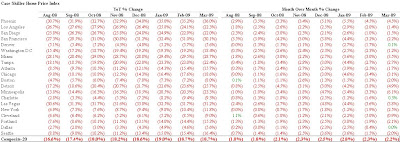
Case Shiller Index - March 2009
The Case Shiller Index fell another 2.2% in March 2009 and now stands 32.2% below its peak level hit in July 2006. Prices have declined to levels last seen in May 2003, with some of the worst regions (i.e. Phoenix, Las Vegas) having retreated to 2001/2002 prices. On a positive note, last month was the first month since August 2008, where sequential increases were observed in any of the index’s 20 metro areas. Denver and Charlotte inked out sequential gains, rising .1% and .3%, respectively. Certainly nothing to get too excited about, but further confirmation that housing is slowly, but surely finding a bottom.



Thursday, May 21, 2009
Railroad Data - Where are the Green Shoots?
If green shoots are indeed sprouting up in the US economy, they certainly aren't showing up in the weekly carload data reported by the Assocation of American Railroads. As suggested in the chart below, carloads are down approximately 25% for each of the last 5 weeks, with declines most severe in heavy metals and scrap (~40-60% declines).


Official Gold Holdings as of April 2009

Here is an interesting chart from the World Gold Council showing the current tonnage of the 20 largest holders of gold. Despite China being the 7th largest holder, gold only represents a mere 1.6% of the country’s $2 billion of foreign reserves – and this is after increasing their holdings from 600 metric tonnes at the end of 2008. As discussed in prior posts, Chinese officials have hinted at their plans to increase their gold holdings to as much as 4,000 tonnes, which could have significant implications on the supply/demand forces underlying the yellow metal. While recent IMF sales have kept a lid on the price of gold, once this artificial selling pressure abates, we could easily see gold surpass $1,000/ton, particularly as concerns over the US’s ability to fund its mounting deficits become a self-fulfilling prophecy.
California Home Prices Stabilizing

Home prices in southern California have declined by 51.1% from their peak levels reached in July 2007. The most severe declines have been in Riverside and San Bernardino (composing the Inland Empire) where prices are down 58.3% and 63.6%, respectively. While prices have declined precipitously from their peak, they have remained fairly very stable at approximately $250,000 since the beginning of 2009. As such, year-over-year volumes have increased approximately 30-50% for each month this year. Foreclosures have driven a significant chunk of this volume, with DQ News reporting that distressed sales comprised 53.6% of total sales in April. In the worst markets, foreclosures account for nearly 70% of sales. While foreclosures and plummeting prices reflect the difficult challenges in California’s housing market, I would argue that the market is firmly in the correction phase. Savvy investors and first time homebuyers are taking advantage of low prices, cheap financing (thanks to the artificial suppression of mortgage rates by the Fed), and government incentive programs (i.e. $10,000 CA home price credit; $8,000 federal tax credit for new home buyers), which in turn is helping the market slowly find a bottom.
Saturday, May 2, 2009
China & Taiwan Make History
Despite being overshadowed by the swine flu news coverage, a major milestone in Taiwan's developing economic ties with China were reached last week, when Taiwan relaxed a 60 year ban prohibiting Chinese mainland investors from buying Taiwanese shares. The two sides have been enemies since Taiwan lost a civil war to Mao Zedong’s communist armies in 1949. Subsequent to the defeat, Taiwan banned any investment from Chinese investors, fearing that foreign ownership would result in the island becoming economically dependent on China.
As evidence of China's growing interest in the island, China Mobile followed the announcement by buying a 12 per cent in Taiwan’s third-largest telecom operator, Far EasTone, for $529 million. Ever since taking over the leadership of Taiwan in May 2008, President Ma Ying-jeou has pledged closer ties to China, and I would expect further investment in the months to come. In fact, there is even discussion of potential reunification, which would be signficantly bullish for Taiwan.
Despite rallying on the news and being up 30% year to date, Taiwan remains over 40% below its highs reached last year. Further, the market trades at a healthy 10x PE. Investors can most easily gain exposure to Taiwan through the iShares MSCI Taiwan ETF (Ticker: EWT). Although I am fairly bullish on Taiwan and believe it represents a cheap way to gain exposure to China, the ETF is highly exposed to the technology industry (as is Taiwan in general), so investors are encouraged to due diligence on the underlying companies. Some of the major components of the ETF include Taiwan Semiconductor, Hon Hai Precision, AU Optronics, HTC, and Cathay Financial. Other Taiwan focused ETFs include Taiwan Greater China Fund (TFC) and Taiwan Fund (TWN).
Subscribe to:
Posts (Atom)

 Posts


